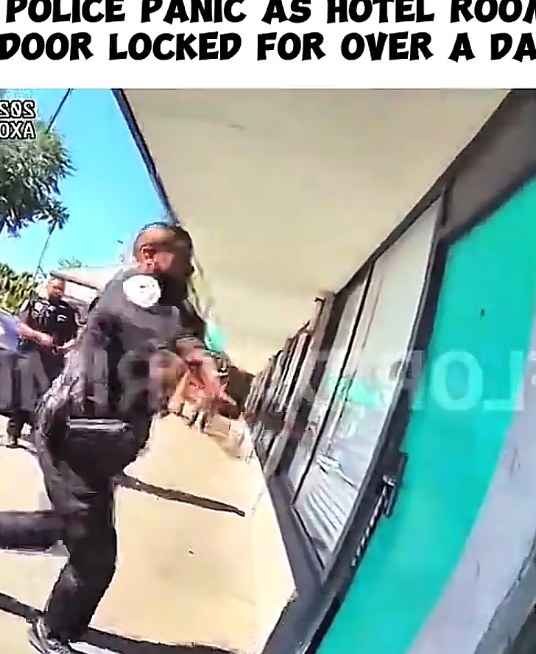
A seemingly routine hotel stay turned into a puzzling situation that reportedly left police officers and hotel staff concerned, after a room door was found locked for an extended period with no response from inside.
The incident unfolded at a hotel in the United States, where staff became increasingly uneasy after noticing that a guest had not been seen or heard from for what was described as over a day. As time passed, and repeated attempts to contact the occupant went unanswered, concern grew that something may have gone wrong inside the room.
According to early reports, hotel staff initially attempted standard procedures, including knocking on the door, calling the room phone, and checking with front desk records to confirm the guest’s status. When all attempts reportedly failed, management escalated the situation and contacted local authorities for a welfare check.
Police officers arrived at the scene and were faced with a difficult decision: how to assess a potentially serious situation without clear evidence of what was happening behind the locked door. With no response from inside and no visible signs of forced entry or disturbance, officers reportedly treated the situation as urgent while also proceeding cautiously.
One officer described the situation as “uncertain,” noting that in such cases, responders must balance respect for privacy with the possibility of a medical emergency or other serious issue inside the room. The possibility that a guest could be injured, unconscious, or otherwise unable to respond is often enough to justify immediate action.
As concern grew, hotel management reportedly provided access to master keys, though attempts to open the door normally were unsuccessful. At that point, officers considered whether forced entry would be necessary if the situation could not be resolved.
However, just as tensions were reportedly rising, a breakthrough occurred. After further attempts to make contact, faint movement was detected from inside the room. Officers then intensified their verbal calls to the occupant, urging them to respond and confirm they were safe.
Eventually, the guest reportedly responded, revealing that they had been asleep for an extended period and had not heard any of the earlier knocking or phone calls. The situation, while alarming for those outside, was ultimately resolved without injury or further escalation.
Police confirmed that no crime had taken place and that the incident was treated purely as a welfare check. A spokesperson stated that officers regularly respond to similar calls where uncertainty about a person’s safety inside a locked room requires careful evaluation before taking further action.
Hotel staff also commented informally on the situation, noting that while it is uncommon for guests to remain unresponsive for such long periods, it does occasionally happen due to deep sleep, jet lag, or exhaustion from travel. In this case, they added, the lack of communication had simply triggered an abundance of caution.
Online reaction to the story has been mixed, with some users expressing amusement at the idea of police being “panicked” over someone sleeping too soundly, while others pointed out that welfare checks are an important part of emergency response and can prevent serious outcomes.
Experts note that situations like this highlight a key challenge for both hospitality staff and law enforcement: distinguishing between harmless silence and potential emergencies. A locked door with no response can mean anything from a guest simply resting undisturbed to a serious medical issue requiring immediate intervention.
Fortunately, in this case, the situation ended peacefully, with no injuries and no need for forced entry. The guest was reportedly advised by hotel staff about the concern caused, and the matter was closed shortly after.
What began as a moment of uncertainty ultimately served as a reminder of how quickly everyday silence can escalate into an emergency response when safety cannot be immediately confirmed.